

- Phishing has made customers wary of unrecognized billing emails, so unfamiliar sender domains are often ignored.
- Trust starts in the inbox: a familiar sender name or domain matters more than design or personalization.
- Generic third-party templates feel impersonal and suspicious; fully branded emails help customers open, click, and pay.
- Consistent branded billing communications build trust and improve engagement, digital adoption, and payment outcomes.
Every service provider sending digital communications is confronting the same challenge: How do you encourage action during a time of heightened suspicion towards unrecognized emails, texts, and calls?
Your customers have been trained by headlines, security awareness campaigns, and their own experiences to treat unrecognized senders with suspicion. Frankly, they’re right to do so. But that means any unbranded billing emails you’re sending are likely getting ignored.
We dove into the phishing landscape and new data on how to combat this customer trust gap in our webinar, “Recognized, Trusted, Engaged: How Consistently Branded Communications Drive Digital Adoption.” Watch the session below or keep reading to get an overview.
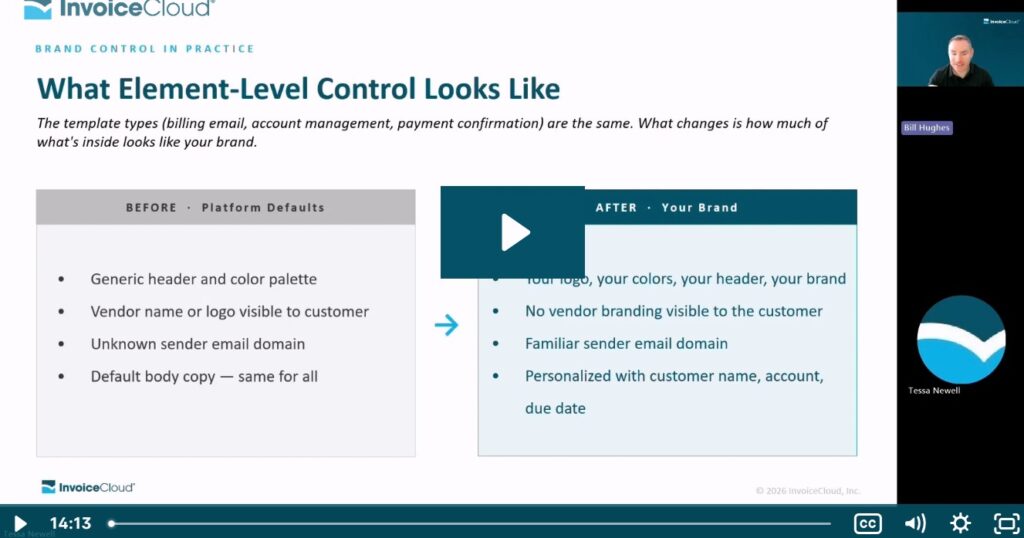
The Impact of Increased Phishing
Phishing isn’t background noise anymore. According to Microsoft’s Q1 2026 Threats and Insights report, Microsoft reported 8.3B detected phishing attempts in Q1 2026 alone.
Year over year, the National Consumers League published a report saying phishing scams increased by over 85% from 2025 to 2026, and the average financial losses caused by such scams have more than doubled from $1,000 to $2,060.
Your customers absorb that message constantly: in their personal lives, in security training at work, in the news. “Don’t click links you don’t recognize” has become reflexive.
And here’s the problem: your billing emails are landing in the same inbox as those threats, often from a domain your customers don’t recognize.
Do Customers Trust Automated Billing Emails from Payment Platforms?
Unfortunately, this landscape is impacting your customers’ willingness to engage with your important communications.
Research conducted with Dynata shows that 1-in-4 Americans are less likely to engage with messages routed through a third-party platform. On the other hand, 1-in-3 trust emails from service providers with recognizable branding. And 27% say they never click links in billing email, regardless of how the email looks.
That last group is largely unreachable through design alone, but the first two groups are reachable. Brand recognition is the mechanism.
Trust is Decided Before the Email Opens
In that same survey, we asked respondents what makes an email feel safe enough to open.
The number one trust signal, cited by 51% of respondents, is a familiar sender name or domain. Not the design. Not the content. The address it came from. Second is an official logo or branded design (36%) and third is a personalized account details (30%).
The sequence matters. Customers make a trust decision at the inbox before they ever open your email. If the sender doesn’t clear that first filter, the logo and the personalization never even get seen.
This is why brand recognition isn’t just cosmetic. It’s the gating factor for everything downstream. A customer sees your domain in the inbox — that’s the recognition moment. Recognition makes the message feel legitimate. Because it feels legitimate, they open it. Because they open it and see consistent branding inside, they engage. Because they’re engaged, they click and complete the action you’re asking for.
Break the chain at step one, and none of the rest happens. Whether you’re trying to drive online utility bill payment adoption, manage insurance payment processing, or streamline the collection of municipal payments, this critical gap must be closed to get better engagement on any email you send.
What Generic Looks Like and Why It Fails
Most online payment platforms send billing emails from a vendor domain. The sender address doesn’t match your organization. The header and footer don’t carry your colors or your logo. The no-reply address is often flagged as spam before a customer ever has the chance to distrust it on their own.
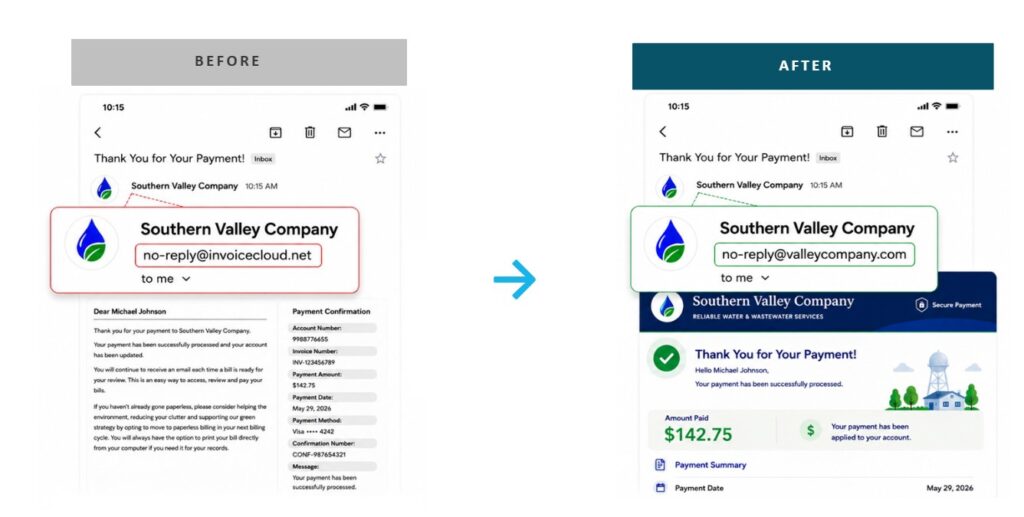
Even if the email reaches the inbox, generic templates read as nondescript, impersonal, and unconvincing. For customers already primed to be suspicious, that’s enough reason not to engage.
The end state you’re aiming for is an email that looks like it came from you and only you. No trace of a third-party payment processing platform. Every element — logos, colors, headers, footers, layout, content — personalized to reflect your organization. That’s what drives opens, clicks, and action.
Branded Experiences Close the Gap
The business case for branded billing isn’t theoretical. When your customers recognize your name in the inbox before they even open a message, trust is built before a single word is read — and 51% of customers cite a recognizable sender domain as their top trust signal.
InvoiceCloud offers the most customizable automated payment reminders. Features like Branded Email Domains is one piece of a broader commitment we’re making at InvoiceCloud: your billing experience should look, feel, and sound like you. From the first touchpoint to the final payment confirmation, customers should know they’re interacting with your organization. That consistency builds the kind of trust that turns one-time payers into loyal digital adopters.
Johnson County Wastewater saw roughly a 22% lift in email engagement within six months of enabling InvoiceCloud’s Branded Email Domains feature, with a direct increase in digital payment adoption to match.
Ready to see what a fully branded billing experience looks like for your organization?

Frequently Asked Questions
Q: Why do customers ignore billing emails?
A: Customers ignore billing emails primarily because they can’t confirm the sender is legitimate. When a payment reminder arrives from an unfamiliar domain — one that doesn’t match the utility, insurer, or municipality the customer knows — it looks like a phishing attempt. Research shows 1 in 4 consumers are less likely to engage with messages sent from third-party platforms. Inboxes flooded with look-alike scam messages have trained customers to delete first and ask questions later.
Q: How does email branding affect payment rates?
A: Branded emails get opened. When billing communications arrive from a recognized sender name and domain, 51% of consumers say they’re more likely to trust and act on the message. Generic or third-party domains erode that trust immediately, leading to ignored reminders, delayed payments, and a spike in customer service calls from payers asking “Is this real?”
Q: What is a custom email domain and why does it matter for billing?
A: A custom email domain means billing notifications reach customers from an address that matches the organization sending them — your utility, your municipality, your insurance carrier — rather than from a shared third-party platform domain. Customers recognize the sender, trust the link, and pay faster. Billing platforms that route communications through generic domains undermine digital adoption, regardless of how secure the underlying payment system is.
Q: How do phishing scams affect digital payment adoption?
A: Phishing attacks condition customers to be suspicious of any unfamiliar digital communication. When scammers mimic billing emails with convincing subject lines and spoofed logos, customers lose confidence in legitimate messages too. The downstream effect: lower email open rates, more paper-based payments, higher call center volume, and slower collections. Organizations that don’t address the trust gap with branded communications absorb those operational costs.
Q: What should service providers do to make billing emails trustworthy?
A: Service providers should:
- Send all payment notifications from branded domains that match their organization, not a vendor’s shared domain
- Use consistent sender names customers will recognize across every communication
- Embed secure, one-click payment links that don’t require customers to navigate unfamiliar URLs
- Provide real-time payment confirmations to reinforce that the interaction was legitimate
- Offer branded self-service payment portals customers can bookmark and return to
- Educate customers proactively about what legitimate billing communications look like
Q: Can a billing platform provider send emails from my organization’s domain?
A: Yes — but not all platforms offer this. Billing and payment platforms that support custom email domains allow your customers to receive communications that appear to come directly from you. This matters because solutions that don’t let you send messages from your branded domains can confuse consumers and undermine digital adoption rates. When evaluating a billing platform, custom domain support should be a baseline requirement.
Q: What happens to collections when customers don’t trust billing emails?
A: Untrusted billing emails create a chain reaction: customers ignore reminders, miss due dates, call in to verify whether a bill is real, and sometimes abandon digital payment entirely in favor of paper. The result is higher delinquency rates, increased call center volume, and avoidable mailing costs — all of which offset any efficiency gains from digital billing. Trust is the prerequisite for digital adoption; without it, the infrastructure doesn’t matter.
Q: How does InvoiceCloud help organizations build trust in billing communications?
A: InvoiceCloud delivers custom email domains so billing communications reach customers from the organization’s own sender name and URL. Clients benefit from consistent sender names and recognizable URLs that assure customers the communication is legitimate — leading to fewer ignored emails, fewer support calls asking “Is this real?”, and fewer delays in collections due to mistrust or confusion.