

- AI spots payment anomalies, return spikes, and delinquency risks early, helping billing teams act before issues compound.
- Automated reconciliation and exception handling reduce manual work, shrink queues, and free staff for higher-value tasks.
- AI improves revenue recovery, digital payment adoption, and audit-ready compliance as transaction volumes keep growing.
Your payment data is telling you something.
The return rate spike in one zip code. The ACH failures clustering around a specific billing cycle. The AutoPay lapse pattern that always precedes a delinquency surge.
The signal has always been there. What’s changed is who’s left on your team to hear it. The senior analyst who used to spot the anomaly three weeks before it hit a report is retiring — or already has. The exception queue keeps growing. Transaction volume keeps growing. Headcount doesn’t.
That gap — between what the data is saying and what your team has the bandwidth to hear — is what AI for payment analytics is actually for. Not magic. Not a buzzword. The pattern-matching work your team can no longer do at volume, running continuously, surfacing the signal where billing staff can act on it.
Here’s what AI-powered payment analytics actually means for regulated industry service providers — utilities, local government, insurance — how it differs from what most teams are running today, and where the operational leverage is real.
What Is AI-Powered Payment Analytics?
AI-powered payment analytics applies machine learning, predictive modeling, and agentic AI to transaction data inside a billing environment. The key word is “inside.” Not bolted on after the fact. Not a separate BI tool that needs an export. Embedded in the workflow where the data lives.
Conventional reporting tells you what happened. AI analytics tells you why patterns shifted, flags exceptions before they compound, and forecasts revenue with enough lead time to do something about it.
For operations managers running a payment system that processes tens of thousands of transactions a month, that distinction is the difference between your team chasing exceptions and your system surfacing them.
A standard dashboard tells you delinquency ticked up in March. An AI-powered billing and payments system tells you which customer segments drove it, correlates it with a billing cycle change, and flags it before your reconciliation team has spent a week finding the same thing on its own.
Descriptive vs. Prescriptive Analytics for Billing Operations
Most service providers today run some version of descriptive analytics: transaction summaries, payment volume reports, channel mix snapshots, exception counts.
Useful. Also backward-looking by definition. You’re reading yesterday’s news.
Prescriptive analytics is a different discipline. It uses historical patterns and real-time data to tell you what to do next: which accounts to prioritize for outreach, when to trigger payment reminders, which channels convert for which customer segments. The gap between those two modes represents real operational cost — in staff hours, in missed recoveries, in delinquency that ages before anyone catches it.
| Descriptive Analytics in Billing | Prescriptive Analytics in Billing |
| Exception and return rate tracking | Identifying accounts at risk of lapsing from automated recurring billing |
| Channel adoption reporting for digital payment services | Predicting which paper-billing customers are most likely to convert to electronic bill payment |
| Reconciliation status by batch or billing cycle | Flagging payment anomalies that signal processing errors before they reach your GL |
| Transaction summaries across payment channels (IVR, web, mobile, in-person) | Recommending outreach timing to maximize recovery on past-due accounts |
Every hour a team spends on manual reconciliation, exception chasing, or hand-building reports is an hour that scales with transaction volume, not with value. AI closes that gap not by working harder on the same tasks, but by making the tasks obsolete.
Key Benefits of AI Payment Analytics for Service Providers
1. Faster, more accurate reconciliation
Reconciliation is where billing operations teams lose the most time. Not because the work is complex, because it’s high-volume. Matching payments to accounts manually across hundreds of thousands of utility transactions, or a county’s full property tax portfolio, is a throughput problem, not a skill problem.
AI-assisted reconciliation flags mismatches as they happen. The end-of-day exception queue shrinks. The team shifts from reactive exception-handling to exception prevention. The staff time you save doesn’t disappear, it redirects to work that actually requires judgment.
2. Predictive revenue recovery
Returned payments, failed ACH transactions, lapsed AutoPay enrollments — all recoverable revenue, if you catch them quickly. The problem is “quickly.”
Manual workflows don’t scale to transaction volume. AI surfaces these signals before they age into bad debt. On a portfolio of hundreds of thousands of accounts, a few days of faster recovery on returned payments compounds into a number your CFO will notice. The math is straightforward once you run it against your actual return rates.
3. Smarter digital payment adoption
Getting customers to adopt digital payment channels isn’t just a convenience play; it reduces cost-to-collect and improves payment timeliness. The challenge is that blanket enrollment campaigns produce predictable results: mediocre.
AI changes the targeting model. It identifies which customers are most likely to convert based on billing history, device usage, and payment behavior, then triggers outreach at the right moment in the right channel. Personalized enrollment beats broadcast every time. The AI doesn’t send everyone the same message; it figures out which message, for which customer, at which point in their billing cycle.
Building the Business Case: ROI of AI Billing Analytics
If you’re building an internal business case for AI-powered billing tools, the ROI argument has three parts — and each one gets stronger as your transaction volume grows.
- Labor cost that doesn’t scale with volume. Manual reconciliation, exception handling, and report generation are all tasks where every additional 10,000 transactions becomes more hours, not harder problems. Automating them through payment and billing modernization reduces cost-to-collect without adding headcount you can’t hire anyway. In a labor market where billing operations roles are increasingly hard to backfill, that matters more than it did five years ago.
- Revenue you weren’t recovering. AI-triggered payment reminders, lapsed AutoPay reactivation, and return payment workflows recover revenue that previously aged out before anyone caught it. Across high-volume portfolios, small improvements in recovery timing compound into significant annual figures. This is the line item that pays for the platform.
- Risk you can actually demonstrate. PCI DSS compliance, audit trail completeness, fraud detection — these reduce both financial exposure and the staff hours spent on compliance reporting. A payment processing platform that maintains audit-ready logs natively is cheaper to operate under audit than a patchwork of manual controls. Security teams are slow-moving voters in any enterprise software decision. A platform that ships the audit trail by default removes their veto a year before competitors figure out they need to.
When InvoiceCloud launched its AI Report Generator, the primary value driver was cycle time: from question asked to answer in hand, hours became seconds. Every routine query that used to require an analyst now takes a billing manager a few seconds to run for herself. The analyst time doesn’t disappear. It redirects to the work that actually requires a human in the loop.
Future-Proofing Your Payment Infrastructure with AI
Transaction volumes in regulated industries are not declining. Ratepayer counts grow. Property tax rolls expand. Insurance policyholder bases scale. A payment processing solution that works at today’s volume but doesn’t have the analytics infrastructure to scale will cost more to operate as volumes increase — either through additional staffing you can’t hire, or through the downstream cost of errors that manual processes can’t catch at pace.
Both are predictable. Both are avoidable.
AI-embedded billing platforms are built for this curve. The analytics layer improves as it processes more data. Pattern detection sharpens, anomaly thresholds calibrate to your specific environment, and forecasting models get more accurate as they accumulate billing cycles. Context compounds. That’s the architecture advantage.
For operations leaders evaluating utility payment or government payment platforms, the architecture question is the one to ask first: does this platform treat analytics as a reporting bolt-on, or is AI embedded in the core workflow? Bolt-on means data exports, manual refreshes, a separate tool, and insights that arrive after the moment to act has passed. Embedded means the signal surfaces inside the workflow, where billing staff can act on it immediately, without a detour through a BI platform.
InvoiceCloud’s embedded intelligence platform is built on the latter model: purpose-built for utilities, municipalities, and insurance carriers — not adapted from a general-purpose fintech stack. The difference is not cosmetic. It shows up in every reconciliation cycle, every exception queue, every revenue recovery workflow.
The senior analyst who used to spot the zip-code anomaly may not be coming back. The system that learns to spot it for you should already be in place.
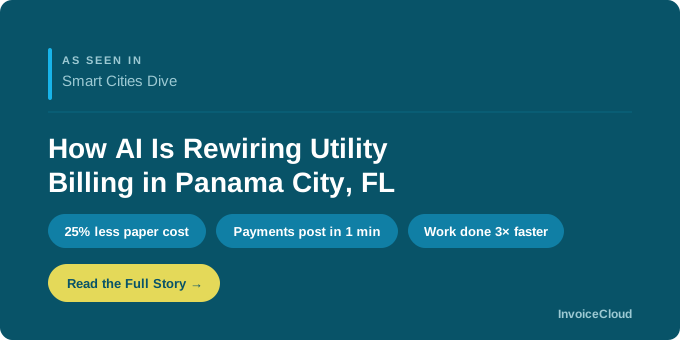
To see what this looks like in practice, read how Panama City, FL is using InvoiceCloud’s embedded AI to accelerate payment posting, improve data access, and trim paper costs by 25%.
Frequently Asked Questions
Q: What is AI for payment analytics?
A: AI for payment analytics refers to AI – powered tools that analyze payment transaction data to surface patterns, flag anomalies, predict outcomes, and recommend actions. In a billing context, it extends beyond standard reporting to include predictive revenue recovery, automated reconciliation, and intelligent payment channel optimization.
Q: What are the benefits of AI payment analytics for billers?
A: Faster reconciliation, reduced manual exception handling, higher digital payment adoption, predictive recovery of lapsed or failed payments, and real-time reporting without an analyst dependency. For service providers in regulated industries — utilities, local government, insurance — audit-ready data and built-in compliance support are additional load-bearing benefits.
Q: How does AI improve payment processing accuracy and reduce errors?
A: AI trained on biller-specific data distinguishes between payment types, flags mismatches against expected patterns, and routes exceptions to the correct resolution path before they reach end-of-day processing. For high-volume billing environments, this significantly reduces the manual review queue.
Q: What is the difference between descriptive, predictive, and prescriptive analytics in payments?
A: Descriptive analytics summarizes what happened. Predictive analytics forecasts what is likely to happen next, based on historical patterns. Prescriptive analytics recommends the specific actions to improve the outcome. Mature AI billing platforms combine all three, moving from passive reporting to active workflow support.
Q: How do billers use AI to detect payment anomalies and fraud?
A: AI monitors transaction patterns against established baselines — return rates, payment timing, channel distribution, amount ranges — and flags deviations outside expected ranges. In insurance billing and government payment environments with strict compliance requirements, this same infrastructure supports audit trail documentation and fraud investigation workflows. The detection layer and the compliance layer run on the same data.
Q: How can billing organizations implement AI payment analytics without disrupting operations?
A: The lowest-risk path is a platform with AI embedded in the core billing workflow — not layered on top as a separate tool. Embedded AI avoids data export dependencies and keeps insights in the hands of billing operations staff without requiring technical expertise or a trip to a separate system. The disruption risk with bolt-on analytics isn’t just technical; it’s adoption. Staff use what’s in their workflow. They don’t go looking for it elsewhere.