

- Commission workflows break under split logic, overrides, compliance rules, and spreadsheet-based reconciliation.
- Slow, opaque payments hurt trust, producer retention, and onboarding, not just operational efficiency.
- Modern carriers map all parties and rules upfront, then automate routing, splits, and approvals at the platform level.
- Real-time reconciliation and self-service payment history reduce month-end disputes and finance workload.
- Fast digital disbursement on modern payment rails, with full visibility, improves accuracy, speed, and carrier competitiveness.
Agent commission workflows sound simple on paper: a policy binds, a producer gets paid. But the actual workflow is a chain of dependencies that breaks under pressure: multi-party splits, override structures, state-specific compliance rules, and a reconciliation process most carriers still run through spreadsheets.
The result is predictable. Producers chase payments. Operations teams spend days reconciling what should be automatic. And the finance team closes the books on a delay, every single cycle.
This is a payment experience problem, not just an efficiency problem. The way carriers manage disbursements — whether claims, refunds, or commissions — signals something to every party in the transaction. Fast, accurate, transparent insurance payment platforms build trust. Slow, opaque ones erode it.
Why Commission Complexity Compounds
A 60/40 agent-agency split looks clean. Add an MGA override that calculates before the split, a sub-producer referral, and suddenly you have four parties expecting payment from one bound policy, each with different banking details, tax documentation requirements, and payment timing expectations.
Traditional check workflows were never designed for this. Sequential endorsements add days. Manual routing creates errors. And the paper check itself is a liability: 74% of check payments were targeted by fraud in 2019.
But the operational cost isn’t even the biggest problem. Delayed commissions affect producer behavior. Agents who aren’t paid accurately and on time route business elsewhere. Onboarding new producers slows down. And your operations team absorbs the dispute calls that should never have happened.
7 Steps Modern Carriers Get Right
There are seven critical steps every carrier must take to ensure disbursement workflows are accurate, transparent, and fast.
1. Map Every Party and Every Dependency Before a Policy Binds
Commission workflows fail when the routing logic lives in someone’s head or in a spreadsheet no one owns. The writing agent, the agency, the MGA, the sub-producer: each has different financial interests, different banking details, and different expectations about timing.
Carriers that get this right document split logic at the producer, agency, and MGA level before disbursement scales. When a transaction triggers, the system reads those rules and routes automatically. No manual calculation. No missed parties.
2. Encode Legal and Contractual Requirements at the Platform Level
“And/or” payment conditions, lienholder release requirements, and third-party assignment agreements aren’t edge cases. They’re standard insurance disbursement scenarios that create sequential approval chains when managed through paper.
Digital authorization workflows replace that sequence with real-time consent and documentation. Approvals happen in parallel where permitted, in the right order where required, with a full audit trail behind every step.
3. Automate Split Calculation Across All Tiers
Percentage-based commissions, renewal vs. new business rate differences, MGA override structures that apply before downstream splits calculate — the logic is consistent, but the permutations multiply quickly.
Manual methods work at small scale and fail at volume. A structured split model, automated at the platform level, removes the calculation error and makes reconciliation possible without staff intervention.
4. Replace Sequential Endorsements with Digital Authorization
Paper-based endorsement processes require each payee to sign before funds move. One missing signature stops the entire workflow. For carriers processing hundreds of commission disbursements per month, the accumulation of these delays is significant.
Digital authorization handles this differently. Parties provide consent electronically. Supporting documentation uploads directly. Approvals route correctly. And every step is logged with a timestamp for compliance.
5. Reconcile in Real Time, Not at Month End
End-of-month reconciliation disputes between carriers and producers are almost always a data visibility problem. Producers don’t know what to expect. Finance teams close against information that doesn’t match what’s in the system.
Automated reconciliation calculates splits, taxes, and adjustments in real time. It maintains a continuous audit trail. It syncs clean data to accounting and payroll systems. Producers access their own payment history through self-service, which reduces the volume of inbound inquiries significantly, particularly at month end.
6. Disburse Across Modern Payment Rails
Check mailing adds days. ACH is faster. Push-to-debit and real-time payment options get funds to producers same-day or next-day.
For agent satisfaction and retention, timing matters. A carrier that pays accurately and fast becomes easier to work with than one that doesn’t. That’s a competitive advantage in producer recruitment, not just a back-office improvement.
7. Build Visibility into the Entire Workflow
The final failure point in most commission workflows is transparency. Producers don’t know where their payment is. Agencies can’t reconcile without manual exports. Finance can’t identify bottlenecks without digging through the system.
A modern disbursement platform surfaces payment status in real time. Automated notifications go to the right parties at the right steps. Producers self-serve payment history rather than calling operations. And carriers track the metrics that reveal where the process actually breaks: settlement cycle time, exception rates, cost per payment.
How Does InvoiceCloud Support Agent Commissions and Other Multi-Party Payment Workflows?
InvoiceCloud handles the full disbursement picture for insurance carriers — commissions, claims payments, premium refunds, vendor settlements, and lienholder releases — on a single platform, under PCI DSS Level 1 compliance, with a 99% reconciliation match rate.
Carriers configure commission split rules by producer, tier, and line of business. When a policy binds, the right amounts route to the right parties automatically. Writing agents, sub-producers, and agency overrides each get paid according to pre-defined rules, with no manual calculation required.
Our 265+ insurance customers also benefit from something beyond the platform itself. InvoiceCloud doesn’t hand carriers the keys and disappear after go-live. Dedicated support teams — named contacts who know your systems and your goals — work alongside your operations team to monitor performance, co-manage adoption campaigns, and flag where workflows are leaving value on the table.
The operational result shows up in the numbers. Carriers using InvoiceCloud see:
- 50% reduction in billing-related manual processes
- 35% fewer invoice-related calls
- 99.9+% uptime SLA that keeps disbursements running through peak processing periods, including catastrophic claims events
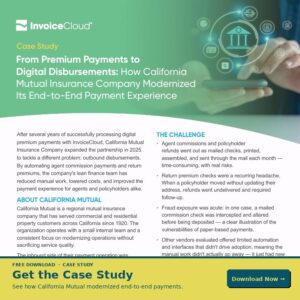
Learn how InvoiceCloud made this a reality for California Mutual Insurance Company after choosing InvoiceCloud for both inbound premium and outbound disbursements.
Frequently Asked Questions
Q: How does InvoiceCloud handle tiered MGA overrides?
A: InvoiceCloud supports multi-level commission structures where an MGA override calculates before downstream splits apply. Carriers configure rules by tier, line of business, or producer agreement — so override amounts are consistent across every transaction without manual intervention.
Q: Can producers access their own commission history?
A: Yes. Producers get self-service access to payment records, including split breakdowns and historical statements. This cuts commission disputes and reduces the volume of inquiries operations teams handle at month end.
Q: How do split workflows handle splits between agents, carriers, and third-party vendors?
A: Split logic is encoded upfront. When a transaction triggers, InvoiceCloud reads the disbursement configuration and routes funds automatically — no manual reconciliation, no sequential approvals.
The rules differ by party type. Agent and agency commissions are percentage-based, calculated against written premium and governed by producer agreements. Lienholder payments follow legal release requirements that must clear before funds move. For corporate lines, vendor and supplier payments tie to invoices or work orders and flow through solutions like SMART Exchange (Transcard’s SMART Solution Suite), which handles the complexity of multi-party B2B disbursements in that space.
Each party has its own authorization chain. InvoiceCloud lets carriers define split logic at the producer, agency, and MGA level so disbursements scale without adding operational headcount.
Q: What are the common legal requirements for multi-party insurance disbursements?
A: Common requirements include obtaining consent from all listed payees, adhering to lienholder release stipulations, and honoring “and/or” language in payment instruments. State-by-state rules add further variation. InvoiceCloud’s 50-state compliance engine adapts to these requirements dynamically, reducing the manual compliance burden on carrier operations teams.
Q: How does automation improve commission accuracy and speed?
A: Automated split logic removes manual calculation errors and compresses payment cycle times from weeks to days. Every transaction carries a full audit trail for compliance.
Q: How can carriers track disbursement performance over time?
A: Real-time dashboards surface payment status, settlement KPIs, and exception rates across the disbursement workflow. Carriers use this data to identify bottlenecks, reduce cycle times, and report on cash flow performance at the board level.