

- Policyholder satisfaction depends on the agent experience, because agents are the relationship carriers rely on every day.
- Accurate, predictable commission payouts keep agents focused on growing business instead of chasing payment errors.
- Fast, transparent disbursements reduce avoidable policyholder frustration and cut the extra work agents absorb.
- Reliable payment workflows build trust, strengthen retention, and make carriers easier for producers to represent.
Carriers spend a lot of energy improving the policyholder’s digital experience. New portals. Better reminders. Faster claims payments. All of it matters. But there’s a piece of the retention puzzle that rarely shows up on a product roadmap: the agent.
Agents are the relationship. When their experience breaks down (delayed commissions, opaque reconciliation, broken disbursement workflows) policyholders feel it too. Not in a way they can name, but in the quality of every interaction they have with someone who’s frustrated, distracted, or spending time on back-office problems instead of them.
Modern outbound payment infrastructure isn’t just a policyholder experience play. It’s an agent experience play. And for carriers serious about retention, that distinction matters.
Payout Accuracy is a Share-of-Mind Problem
Agents manage relationships across multiple carriers. The ones that pay accurately and on a predictable cycle earn more attention. The ones that don’t get deprioritized — quietly, at renewal, in the coverage conversation, in how hard a producer works to resolve a question before it lapses.
Commission workflows that are manual, fragmented, or error-prone don’t stay in the back office. They show up as redirected attention: producers spending time chasing payment accuracy instead of growing a book of business.
Disbursement Delays Become Unscheduled, Additional Work
Every stalled refund or delayed claims payout generates downstream contact. Most of it reaches the agent before it reaches anyone else. Finance sees it in exception queues. Agents absorb it as conversations they didn’t plan for, defending a carrier process they can’t see into, for a policyholder who’s already frustrated.
Carriers that process disbursements faster, with real-time status visibility across refund and claims workflows, reduce that escalation loop. Fewer inbound inquiries per payout event means agents spend more time on growth and less on damage control.
Payment Flexibility Gaps Create a Lack of Trust in Deliverability
A disbursement that fails because the recipient’s preferred payment channel wasn’t available doesn’t just create operational rework: It creates a conversation no agent wants to have.
Someone has to explain why the payment didn’t arrive. That moment erodes policyholder trust in the agent and the carrier simultaneously, making producers more likely to steer business elsewhere.
Commission Reconciliation Compounds Across the Entire Company
When commission statements don’t reconcile cleanly against policy and premium data, agents raise disputes, finance teams research discrepancies, and the correction cycle pulls resources from every function at once.
InvoiceCloud customers are already using our award-winning AI Report Generator to accelerate reconciliation workflows, reducing reconciliation time by as much as 75% — from two hours to 30 minutes a day. The same logic applied to commission workflows removes the administrative drag that weakens producer confidence and keeps finance staff occupied with work that adds no value to anyone.
Agents are the Touchpoint Behind Policyholder Retention
Policyholders who built their coverage relationship with a specific agent face real disruption when that agent leaves. Carriers with unreliable commission cycles, poor tooling, or fragmented disbursement workflows see higher producer turnover than those that invest in the agent-side operational experience.
The connection between agent satisfaction and policyholder retention doesn’t show up in loss ratios. It shows up in renewal rates, mid-term cancellations, and the cost of rebuilding a book of business that walked out the door with a producer who moved on.
Digital disbursements that are slow, opaque, or unreliable create friction at every point in the carrier relationship. Instant refunds reduce the moments where policyholders lose confidence. Reliable commission workflows reduce the moments where agents lose focus. Together, they make your carrier the one producers want to represent and policyholders want to renew with.
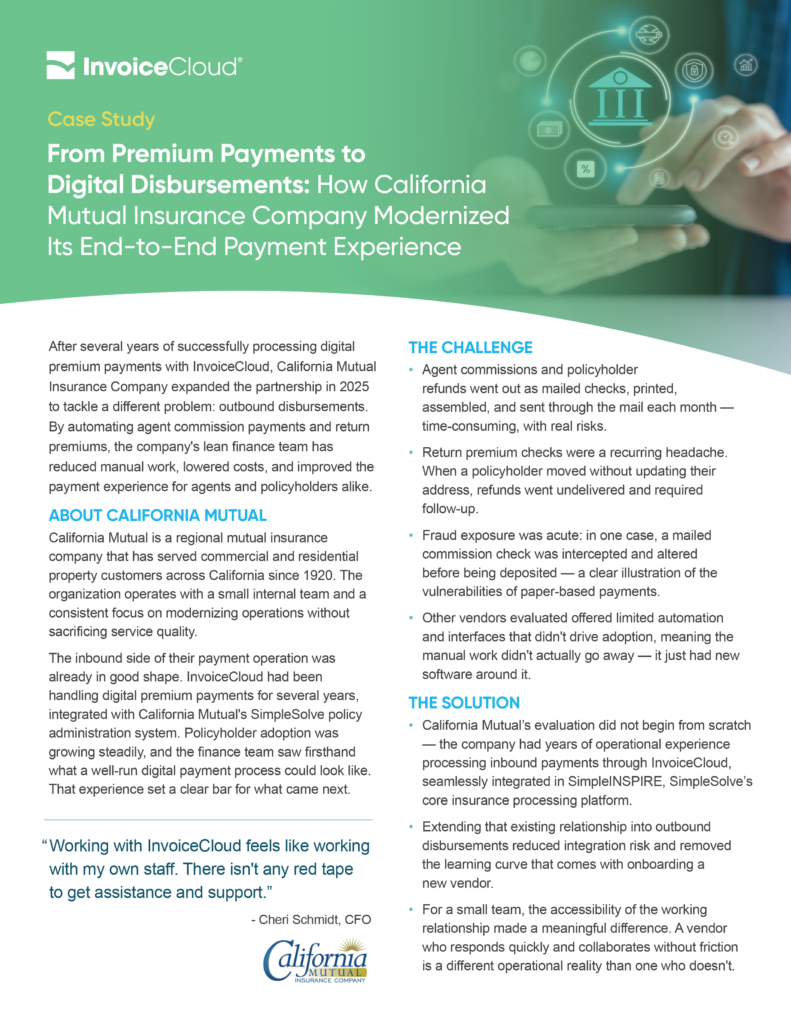
Case Study: California Mutual Optimizes Its End-to-End Policyholder Experience
Modern payment infrastructure makes this achievable: instant refunds, reliable commission disbursements, real-time status visibility, and integrated reconciliation — managed from a single platform built for insurance complexity.
California Mutual Insurance Company modernized the full scope of its payment workflows with InvoiceCloud’s end-to-end insurance payment solution and is already getting positive feedback from the new and improved policyholder experience.
Get the case study below to read their full story.
Frequently Asked Questions
Q: What Are Real-Time Digital Disbursements and How Do They Work?
A: A real-time digital disbursement is the process of sending funds to a recipient quickly through digital payment rails instead of relying on paper checks or slow batch workflows.
In insurance, that includes approved claim payouts, premium overpayment refunds, billing corrections, agent commissions, and other outbound payment events that need to reach their destination with less delay and more visibility.
These workflows typically depend on integrated real-time payments, modern payment rails, and digital disbursement infrastructure that help insurers replace manual payout steps with more automated, trackable processes across every recipient type, including agents and policyholders.
Q: How Are Instant Refunds and Commissions Processed Digitally?
A: Instant refunds are immediate or near-immediate digital credits issued to policyholders after a billing correction, overpayment, cancellation adjustment, or approved insurance-related refund event. They are processed through integrated payment workflows that reduce manual handling and help resolve issues faster.
Commissions are where the agent connection becomes concrete. In insurer operations, these critical outbound payments are tied directly to producer activity. When commissions arrive on time and without manual reconciliation errors, agents can focus on what they do best: building relationships with policyholders. When they do not, agents spend time chasing payments, questioning accuracy, and absorbing administrative friction that was never their job to carry.
Q: How does instant refunds and commissions logic get configured in a billing platform?
A: Payout logic in a billing platform is typically configured around workflow rules, approval steps, payment methods, eligibility conditions, timing, reconciliation logic, and reporting needs. For carriers managing both policyholder refunds and agent commissions, the strongest approach uses payment orchestration to manage payout logic consistently across use cases and recipient types.
Supporting industry overviews of payment orchestration and the infrastructure behind payment rails explain how these workflows scale — and why keeping commission and disbursement logic in a unified platform is better than managing them in disconnected systems.
Q: How do instant refunds improve policyholder satisfaction?
A: Instant refunds in insurance are fast, digitally processed credits issued after approved billing adjustments, overpayments, or related refund events. They improve policyholder satisfaction by reducing wait times, increasing clarity, and making resolution feel immediate and fair.
Q: What compliance considerations apply to instant refunds and commissions?
A: Compliance considerations typically include secure payment handling, auditability, reporting accuracy, approval controls, and alignment with internal financial and operational policies. The goal is to move money quickly — to policyholders and agents — without losing visibility or control.
Q: Which payment rails support real-time digital disbursements?
A: Common rails include ACH, push-to-debit or card-based disbursements, and digital wallet options where supported. The right mix depends on speed requirements, recipient preference, and operational needs — whether the recipient is a policyholder waiting on a refund or an agent waiting on a commission. (source)
Q: Which platforms support real-time digital disbursements for claims and refunds?
A: Platforms that support digital billing, payment orchestration, outbound payments, integrations, and reporting can help insurers modernize claims payouts, refund workflows, and agent commission cycles. Solutions like InvoiceCloud are designed for insurance-specific disbursement experiences are especially valuable when carriers need to manage both inbound and outbound payment complexity.
Q: How do instant refunds and commissions improve policyholder satisfaction?
A: Policyholder satisfaction is shaped by what happens at the moments that matter most — a billing correction, a claims payout, a renewal conversation with an agent. Faster refunds reduce friction directly. Reliable commission payments reduce friction indirectly, by keeping agents focused on the relationship instead of back-office problems. When the entire payout ecosystem runs cleanly, policyholders feel it — even if they never see the commission ledger.